Monday, April 25, 2011

Salvation !

Posted by Sarah:


Born from the boredom of weekend office workers, Paint the movie, Guess the movie is my brand new blog where you can test your movie knowledge, and if you are brave enough, your drawing skills. Enjoy!

 A sample: 

Thursday, November 4, 2010

Seabed cleanup at il-Foss

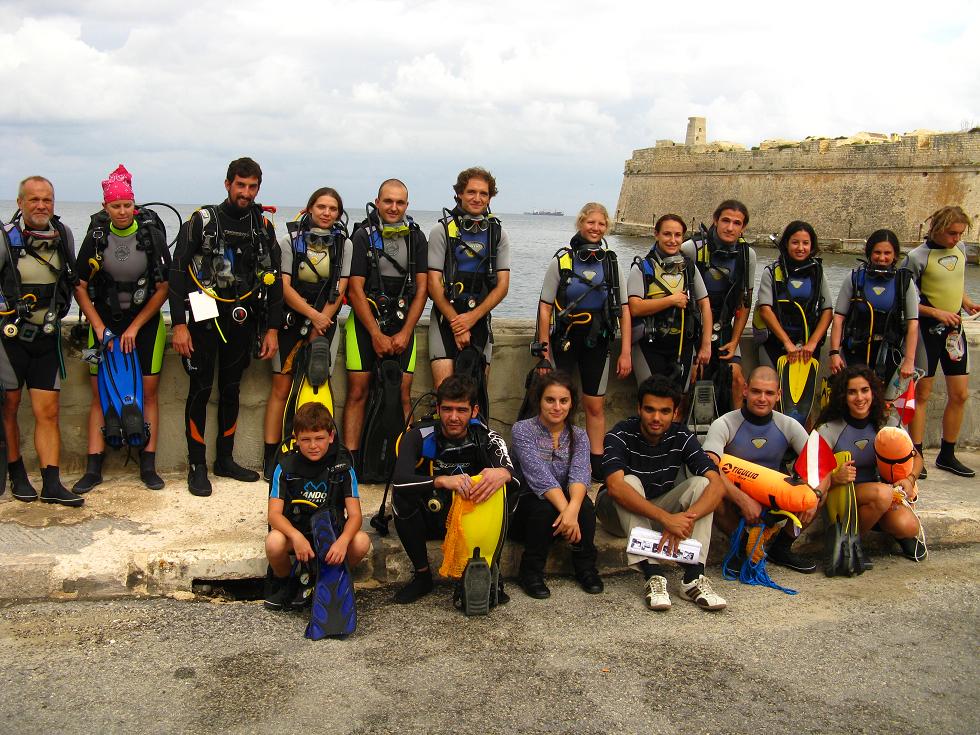
As soon as my mates Jason (Chubbie) and Patrick asked if I would help take part in an underwater cleanup of the Foss dive site in Valletta, I immediately accepted.
Jason and Patrick run the Watercolours Dive Centre, which has a school in Sliema and another in Valletta. It was a few years ago that I began to dive and these two fellows were my instructors.
The cleanup was scheduled for a Saturday morning, but the weather was absolutely savage. There were high winds and the island was lashed by storms the night before. It would have to wait. In the event, it was moved forward by a week, with the hope of there being some better weather.
On the day, it was raining and cloudy, but it was very muggy so it wasn’t going to be too cold, especially seeing as there was steaming hot tea, coffee and biscuits available.
I was to take part as a buddy team leader. I know the site very well, having been my learning ground and having a fair amount of dives under my belt, I was to lead a team of four. The Foss area is a harbour dive, and although it is at the mouth of Marsamxett, there is a remarkable ecosystem which thrives.
Flat fish skim the sand bed and bury themselves there, their only giveaway being two tiny beady little eyes. Seahorses cling onto algae for dear life as they sway in the current while Scorpion Fish lurk in dark holes and against reefs, where they are almost invisible. Fireworms crawl around the fissures, while colourful nudibranches attach themselves to anything which doesn’t move. Octopus, cuttlefish, sea urchins, red mullet and many others can all be found in this area.
Of course, one must not forget the HMS Maori – a real WWII wreck lying half buried in sand at a depth of 14-18 metres. She is one of those old, old ships that looks like she belongs to her environment. Brown and rusting, she is home to myriad life forms, and a lovely relaxed dive to boot.
During the briefing, Jason explained to the whole group that one has to be careful in picking rubbish off the seabed. We have seen octopi living in kettles, spider crabs living in broken glass bottles and shrimps in any little nook and cranny that they can find. Scorpion fish love to settle themselves into crevices and metal poles and tubes can make quite a nice home for them.
The cleanup team needed to understand an important point – on a cleanup, it is important to not cause more harm to wildlife than good. You cannot lift a piece of debris out of the water if it has significant life on it.
Briefing done, we entered the (shockingly) cold water and buddied up into our teams. I checked with the four other divers and they were ready to go… all give the okay, thumb down and off we go.
As soon as you equalize and get to the seabed, which is only at about six metres in depth, the volume and array of rubbish really does hit you. Of course, what would be an easy task on land soon becomes a complicated problem underwater. Trying to get hold of swollen cigarette butts and lighters is a completely different ball game – add a bit of a current and busy divers to the mix, and it soon becomes a bit congested.
Within minutes, we had picked up countless fag ends, plastic bottles, broken glass bottles, bits and pieces of plastic and more. My find of the day was a rug which had been dumped into the sea.
Knowing that it might be full of life, I unfolded it – again, no easy task, and shook it out as best I could and handed it to the snorkeling team at the surface, to take it to shore. Though I tried my best, there was still one spider crab hanging on for dear life by the time the rug made it to the rubbish pile, but someone spotted it and put it back into the sea.
By the end of the afternoon, we had collected a substantial amount of  rubbish ranging from a car alternator, bar stool, a carpet and a set of dentures. This is to be taken in the context of another cleanup having been held some three weeks earlier.
Another big problem is detritus and rubbish which is left on the foreshore. If it is windy, or rainy, all that goes into the sea.  The sea is our collective heritage, as mankind. This was put forward as a resolution to the United Nations by Malta. The resolution was passed, but the reality is that the seabed is “out of sight, out of mind”. We, as an island people are intrinsically linked to the sea. We should protect it and that means stopping overfishing, shark finning, dumping, drilling and much, much more. We have one world, one home; we need to preserve it.


Thursday, October 7, 2010

I like it on the… table?


Men around the world have been left scratching their heads this week as the latest joke on Facebook is doing the rounds.
Only a few months after the fairer sex decided to confuse the hell out of men by posting “sky blue”, or “black”, or “red” next to their Facebook status, this time it’s “Mary likes it on… the floor, table or chair”. Maltese men are no exception to the world and have also been skilfully duped.
The last joke was all about the colour of underwear they were wearing, but this time, it’s not at all about favourite positions… but… about where they like to leave their handbag. Many blokes have posted comments under these status updates with moments of hilarity for all and sundry. “Er can I help?”, “you like to do what on the table?”, “good point noted”, are all some of the retorts which brainy and charming fellows have come up with.
But, the joke is on us male-kind. Women are not trying to subliminally tell us how they like to... enjoy down time, they are simply, to put it bluntly, taking the Mick. Apparently, the worldwide prank goes something like this. Girls send each other the following email: “Ok ladies here’s another game, like the bra colour game which was a total success and we had men wondering for days what was with the colours, and it made it to the news. Well, this game has to do with your handbag, where we put our handbag the moment we get home, for example “I like it on the couch”, “I like it on the kitchen counter”, “I like it on the dresser” – well, you get the idea. Just put your answer as your status with nothing more than that and cut and paste this message and forward to all your female Facebook friends to their inbox. The bra game made it to the news. Let’s see how powerful we women really are!!! REMEMBER – DO NOT PUT YOUR ANSWER AS A REPLY TO THIS MESSAGE, SIMPLY PUT YOUR ANSWER AS YOUR STATUS, THEN FORWARD THIS MESSAGE TO YOUR FRIENDS.” So there you go lads, they got us all again.

Monday, October 4, 2010

The Imperial Eagle and the Christ statue

We set off early doors from the dive centre in St. Paul's Bay to catch a luzzu out to the site of the Imperial Eagle and the Christ statue. A couple of mates, Karl and Claudia,  asked me to join their group for a boat dive to visit the Eagle and by default, the statue. I had never been diving with them before, but we are at about the same level and decided a group trip would be nice. For me, it was a chance to meet different people on the local dive scene as well as a first visit to this particular site. I can never resist the lure of a wreck, so I thought why not.
We prepped up on the jetty, loaded up and off we went. On the way there we kitted up and Karl and I buddied up and we split into groups of four. Our guides were Nat and Reiny (cheers lads) and we were the last to go down. The descent on the line is a fast one, and if you can get your equalizing right first time, you can pretty much descend all at one go and hit the bottom at 42 metres. The first things that come into view are the posedonia meadows, giving you a sense of perspective. You sink pretty fast and the viz isn't that great, it was about 15 metres at best when we were there. Anyhow, we went round the the Imperial Eagle first as the Christ statue was a bit busy.
The Eagle is a grand old lady. She looks ancient and feels very much as if she belongs in another era, and that is probably because she does. She was launched as the New Royal Lady in 1938 and served as a pleasure cruiser ironically near where I used to live on the spectacular coast of North East England. She was used in Scarborough and Whitby, two fantastic and picturesque towns I know very well. She was requisitioned by the Royal Navy and was later attached to the US fleet. She survived the war and was put back to work, first as on the Firth of Forth, then on London's Thames and finally, on a regular ferry route in Southend.
The Crested Eagle, as she was then known, was purchased by E Zammit & Co Malta and was renamed the Imperial Eagle. She was put on the Mgarr to Marfa route and served it for an amazing ten years from 1958 to 1968. She was then sold on and was used to transport animals and cargo to and from Gozo. In 1999 she was  scuttled at her present resting place - half a kilometre off Qawra point. If she seems big, that's because she is, she is 141 feet long and could take 70 passengers and 10 cars. She has been underwater for close to 10 years now and sports some thick vegetation. Your first stop will probably be the wheelhouse, a nice experience and then you can head round the side and swim under the propellers which are still clear. From there you might want to head up and over into the aft section, where you can worm your way through the missing decking to enter the bowels of the ship and descend right into the keel. For more information check out http://www.marinefoundation.org/projectsimperialeagle.htm
From there, you can head round to the Christ Statue. This impressive, larger than life 13-tonne fibreglass covered concrete statue was designed by Alfred Camilleri Cauchi.  It had cost over Lm1,000 and was commissioned by a committee of divers led by Raniero Borg purposely set up to commemorate Pope John Paul II  visit to Malta where it was lowered onto the seabed close to St Paul's Islands.  Ten years after it was lifted out of the water and once again lowered out at sea, this time off Qawra Point. The statue is impressive to say the least and it takes on a life of its own under water. It is well worth spending a couple of minutes just looking at the statue from different angles as it really is a work of art with a difference.
From there, you can take a leisurely swim under a natural arch formation and make your way back to the line. If you are lucky, you will not have racked up too much deco time http://maltadives.blogspot.com/2010/09/21-minutes-on-line.html

Wednesday, September 29, 2010

Investing in niche markets

This is the leading article published on today's issue of The Malta Independent, of which I am editor:


The Malta Tourism Authority yesterday announced that it would be scuttling two wrecks within two years to supplement diving attractions around Malta.
This is very welcome news to the local diving community, but the benefits are much more far-reaching. Let us look at money first. Malta is known to be one of the top diving destinations in Europe, if not the world. We have clear blue sea with great visibility, and abundance of wildlife that belies the expression ‘the dead Med’ and we have a great climate which allows diving all year round.
Malta already has the reputation of a top diving destination with the jewel in the crown being the Um el Faroud wreck which was scuttled in Zurrieq. There are plenty of natural dives, including reef dives, cave dives and nature dives. But the most popular form of diving attractions are, without a doubt, wrecks. 
Malta is also blessed with several ‘natural’ wrecks which were sunk during WWII, but most of these are at a great depth and are only available to tech-divers who dive on mixed gases. The bulk of divers are recreational divers who do not usually exceed 40 metres depth. 
The MTA sunk two wrecks in 2007 and 2009 – two former patrol boats. One is in Cirkewwa and the other near Comino and both have proved to be very popular with local and foreign divers who visit Malta for sport.
Malta currently attracts some 60,000 divers per year, but the figure could be so much higher. Just like with all our other attractions, the dive sites are all within an hour’s travelling distance and it is possible to dive two sites in one day.The weather, as we have mentioned, allows for diving all year round and it does actually happen. One of the boats, an as yet unnamed tug, will be scuttled off Exiles point in Sliema. In all probability it will not be a shore dive as traffic is rather dense in that area and would, most likely, be sunk further out to sea to become a boat dive.
The other vessel, former AFM patrol boat P33, is set to be scuttled in 2012 at an as yet undisclosed location. Of course, the scuttling is pending approval by Mepa. But like other wrecks, if they are correctly sited and avoid damaging posedonia meadows, then they will be teeming with life within a couple of years and will become artificial reefs.
But while we have a gem of a product, we must fine-tune it and the authorities must listen to divers. While there have been attempts to improve facilities for divers, these have largely been restricted to entry points – in other words, where they get into the water. But we must provide more than shiny handrails and ladders. We must continue to invest in this sport to gain maximum results and to continue to boost the numbers which come here. Simple measures such as putting up a canopy to allow shelter from the blistering sun (or rain) when divers are kitting up and showers for divers to rinse themselves and their kit, would be a welcome start. We must also continue to advertise our product. TV spots are important, but the diving community is a diverse one and the opportunities we can tap into by having a dedicated online presence to present our underwater riches to those who are actively seeking information is imperative.


read also: http://www.independent.com.mt/news.asp?newsitemid=112847

Tuesday, September 28, 2010

More wrecks!


The Malta Tourism Authority has decided to scuttle two new wrecks, one next year off Exiles Point and the other in 2012 at a site yet to be identified.From what can be gathered, a tug is to be scuttled off Exiles point. This would presumably put the wreck at a depth of about 30-40 metres. Exiles Point is already home to the Beaufighter wreck.
P33 photo Stephen J Borg
The MTA plans to scuttle another vessel in 2012, the former AFM Patrol Boat P33. The patrol boat, which is 23.33m long, 4.7m wide and approximately 7m tall when measuring from the top of the mast down to the draft of 1.87m.
The two wrecks will add to the P29 and the P31 which were scuttled in Cirkewwa and Comino in 2007 and 2009 respectively. The vessels will be sanitized to allow safe diving and will be cleaned to ensure no damage is done to the environment. Their scuttling is subject to MEPA approval.

Wednesday, September 22, 2010

21 minutes on the line

What can be more painfully boring than hanging onto a rope for 21 minutes. 
Well, you might find that watching grass grow, or paint drying is more tedious But holding onto a bhuoy's anchoring rope at between ten and five metres depth is just about as tedious as things can be.
The dive was a boat dive on the Imperial Eagle, off Qawra point. It was a great dive and after the Eagle, we stopped off at the Christ Statue, Kristu l-Bahar and then went for a saunter under the natural archway which is over there. Maximum depth was 42 metres.
We got back to the rope and the computer beeped. 21 minutes of mind-numbing tedium while hanging onto a rope. Needless to say, we got cold and my buddy Karl and I just hung on the line. Needless to say, as tanks got lighter, we switched to positive buoyancy and there was a good deal of fiddling with the BCD release valve. Every minute, we flashed the countdown and every time, we gave the OK. 
A long deco-session later, we slowly surfaced and got back on the luzzu. We were still cold when we got back to dry land. The dive was well worth it, but if you're planning a dive where deco is involved, it definitely time to dig your hoods out. Summer is over and it's inching towards October. The sea is still warm, but it's definitely cooling down. 
What's your longest decompression stop and where?

Friday, September 10, 2010

The Lady Davinia

Do you remember the little wooden pleasure boat which used to be painted in a garish red Kit-Kat colour scheme? That was the Lady Davinia.
It’s hard to believe that the little ship had three lives. It’s first was as HMS Greetham in the Royal Navy as a mine sweeper. She was commissioned in 1955 as one of 93 ships in the Ham class. Each vessel was named after a British village with the ‘Ham’suffix.  She was built out of wood and non ferrous materials, so as you can imagine, she is quite an interesting wreck.
She is 32.5 metres long with a beam of 6.4 metres. The crew complement was 15, but rose to 22 in wartime. She was powered by two Paxman diesels, rated at 550bhp and generating a top speed of 14 knots. You can still see the engines, but more on that later.  
HMS Greetham was loaned to the Libyan Navy in 1963 as part of the country’s first Navy. She was transferred permanently in 1966 and was renamed the Zuara. Information is limited, but she seemed to be used for coastal patrols. She was decommissioned in 1973 and after languishing in dock, she was acquired by a Maltese tour operator. She was renamed the Lady Davinia and was perhaps best known for the red Kit-Kat scheme.  From 2007 onwards, she was laid up at Sliema Creek, then one day, after a few days of storms, she simply sank at her moorings. No one knows for certain when it was, someone just realized that she was missing.
The dive itself is easy enough, she can be found at 17 metres on a sandy bottom. But viz is pretty bad and it can get a bit disorientating.
My buddy and I plumped for entry just below the Fortina Hotel, where the steps down to the sea are and there is a ladder which you can use to exit. It did not take us long to find her. You simply swim straight out and there is a large metal chain on the bottom which was her old mooring. As soon as you find it, you just follow it to the wreck.
If you hit the Davinia nose on, she sort of jumps out at you. The water has a greenish turquoise tinge and its one of those “Is it? Isn’t it?” moments. All of a sudden, her outline becomes clear and out of the murk, you spot her. With her having sank at her moorings with all sorts of ropes and chains around her, she has a dense covering of vegetation, but you can clearly see some of the old colours underneath.
The Lady Dav is a very odd wreck. The first thing you need to realize is that she is not a purpose sunk wreck. If you are not careful, there are plenty of pitfalls – closed hatches, jagged screws, rotting wood… Your really do need to watch what you were doing. The wheelhouse, which has blue exits either side, is a time capsule and it literally seems frozen in time and space. You could almost sit down and sail her off.
http://www.scubaworksmalta.com/lady-with-a-lovely-name-davina/
Once you tour the wheel house, you can have a look in the small galley and have a fiddle with the knobs on the cooker. From there, it’s a trip down to the poop deck and you can descend through a hatch to the engine room. It is tight, so be careful. You must also be careful in which hatch you enter. One is through a flu, the other is a proper hatch. I’m a very slim guy, but I could barely squeeze in the flu and decided against it after getting half way in. We did, however, enter the other hatch and have a look at the engine room, which is immaculately preserved. Being made of wood and plastics, the Lady Dav is a in pretty bad way. I doubt if she could ever be raised and resunk as a diving attraction as she would probably break up. Do be very, very careful. In hindsight, we should have realized. My buddy and I were heading back, but we seemed to be making no headway whatsoever. We were stuck at 12-metres and we were drifting into each other. We swam for a good 15 minutes and realized that we must have got caught in a current. We decided that the best bet would be to surface and see where we had ended up. We purged some air and slowly rose to the surface. We were a good 400 metres off the side of wreck site and a little further out than we should have been. That’s a current for you. We decided to make our way in at the surface. All in all, a great eventful dive. Have a look for the kiddies’ chair on the sea bed just before the great chain I mentioned – great photo op J

Wednesday, September 8, 2010

San Dimitri and the earthquake legend

If you were to ask people about their experiences of diving in Gozo, they will probably tell you what a fantastic dive they had in Dwejra or Crocodile Rock or the Blue Hole.
These are all fantastic dives, but let’s face it; when you are faced with the diving riches in Gozo, you might as well go full whack. Last time I went, we dived the Billinghurst Cave and Reqqa Point and after a quick lunch, we decided to go to San Dimitri – behind Gharb. Legend has it that there was an earthquake many hundreds of years ago, which led to a chapel, which was built on the Cliffside, to fall into the sea in one piece. Apparently, the bell still chimes on religious feast days. It is not difficult to understand where the legend sprung from and I will explain later. video
But first, a bit of excitement. As a guy, it’s always a rush to be on something fast and powerful, which is exactly what we needed to get us to the dive entry point. San Dimitri is a beautiful dive, but can only be reached by boat. We chartered a rhib from Dwejra for the afternoon and powered out of the inland sea, crashing along the waves for about 15 minutes in full kit. We felt like Navy Seals about to embark on a mission.
video
One we arrive at the spot, and after an OK, it was a summersault back entry… oh and what a view. Visibility was easily 50 metres and we slowly descended to about 20. The underwater topography is phenomenal. It literally looks like an earthquake had shattered the coastline and sent it tumbling into the sea.
video

I had a bit of trouble with ear lock on the dive, but I was able to hang around above the rest of the party at about 18 metres or so, and in a sense, the view was even more impressive. The amount of marine life which congregates and proliferates in this spot is simply beyond belief. In fact, we saw a massive shoal of striped barracuda and proceeded to herd them into a ball. Two went left, two went right, one went above and one went below and before we knew it, we had herded a whole shoal of the fish. We could go right up to them and they would not break – it was a truly amazing experience.
We also saw plenty of groupers and various other small fish, which were actually not that small by Malta standards and these included parrot fish, cawl and myriad others. After about 40 minutes of enjoying such beautiful surroundings, it was back onto the boat and we powered to shore. Needless to say, after two such dives we were knackered and nearly falling asleep on the ferry back to Malta. What a wonderful dive !

Videos Jason Fabri

Tuesday, September 7, 2010

Billinghurst Cave and Reqqa Point

3 August


Me with the cave entrance in the background
Photo Jason Fabri
Today was my first dedicated cave dive at the Billinghurst Cave near Qbajjar in Gozo. It was an early doors start, catching the 8.15am ferry to Gozo. After landing, we headed off to Zebbug and wound our way down the precarious road and tracks to the Billinghurst Cave entry site, near Reqqa point. Getting to the Cave entry site is a bit of an operation and you have to be very careful to avoid falling onto the very sharp rocks. You cannot exit the water from there and you have to swim round Reqqa Point to get out of the water.
But back to the cave. Buddy check, inflate BCD, giant stride and a one-metre drop into the water. It was a relief in the 30 degree heat. A quick ok and off you go, a quick decent to 20-29 metres and the cavern opens up. You look down the 120-metre long tunnel and all you see is black. As I have mentioned, this was my first cave dive, but we had torches and the experienced Jason Fabri from Watercolours Dive School with us, so I wasn’t overly concerned. A good tip is that if you feel claustrophobic, just look back, there is a massive turquoise window that is very reassuring.
Coral in the cave
Photo il-Bagigu
It is worth noting that the cave tunnel allows for three divers to easily swim up to the cave side by side. At a squeeze four can do it.  It is a sandy bottom too and there is not much danger of silting either. If you look at the walls on your way in, there is a lot of coral and a lot of miniscule sea life, but more on that later, you get to see it in its full glory on the way out.
The journey into the tunnel is a bit eerie, and you do have to do some torch waving to ensure that your group sticks together. But, it is perfectly acceptable to use the torch in burst flashes rather than as a continuous beam.
There are also some reassuring lines which have been put in place to guide you in or out of the tunnel. It is also slightly deceiving as you do not all of a sudden come to the surface. The tunnel slopes up gently and after a final gentle bend to the right, you come across a tighter area where the height of the tunnel shortens to about five metres. You negotiate some boulders and that is your final cue. If you look up, you can see that you are near the surface.
Me in the Billinghurst Cave
Photo Jason Fabbri
There are no obstructions and the dome of the cave is more than big enough to allow you to surface without worry. Once you do, you look at the majesty of it all and realize that you are at sea level and that the roof of the cave is a good 10 feet above you.
A few deep breaths of air, blow your nose and turn on the torches and you are in a place where not many others have been before.  You feel elated, full of wonder and you realize that you must be directly under a hill because the dome is so high above sea level.  A couple of jokes and photographs later and it’s time to leave.
We decided that we would head back out without torchlight and just aim for the turquoise window. You do not see it at first because it is round the bend, but you do see a faint glimmer that is ‘round the corner’. A small word of advice – wear gloves and a full length suit if it’s your first time. You can kind of bump and scrape across a few rocks and you can get some cuts and grazes if not careful. But do try and fin and wave your arms – the bioluminescence show which you receive in return is absolutely spectacular.
Photo Jason Fabri
 On the way out, it's an even better treat as hundreds of fish, jellyfish and various other forms of undisturbed marine life come to literally, check you out. Groupers, mauve stingers, kahli; the range of life is incredible. Do keep a watch on your dive computer though, it's all to easy to forget that this has been two dives in one. The exit points can be a bit dodgy, especially if the sea is a bit rough. 
You might want to attach some rope to a couple of places, just in case it's a bit too difficult to get out. The swim round the drop off is quite fascinating and the underwater topography is quite stunning. This is a great dive. And it's unspoilt. Check out the videos by Jason, featured below.


video


video


Thursday, September 2, 2010

The long road to the Arctic

Phase one complete. I have handed in EUR1,000  to the S.P.C.A, the first sum of money I had to raise to take part in the 8.97 Bay Arctic Challenge. What are we doing? Well, I’m joining a few other people who are willing to spend one week in a log cabin and snow hole in Sweden’s far northern reaches in March next year.
The reason we are doing it is to raise money for the S.P.C.A’s new centre in Ta’ Qali. Make no mistake, it’s going to cost a lot of money. We need to raise about eur40,000. And that works out to EUR2,000 per contestant, a further EUR200 in registration fees and a further God knows how much for equipment to take to the Arctic!
So far, I managed to get EUR165 in donations from private individuals. There are also some promises of funding from Corporates, but raising money (I am fully endorsed to do so by the SPCA) is no easy task.
Some of the guys have already organized some events. One of which was a sprint-triathlon in Birzebbuga. A fellow challenger and I, Owen “the body” Jones, took part and this was for two reasons. The first was to show some solidarity with people who are organizing events, and the second reason was to get fit. It was an absolute nightmare. We both honestly felt as if we were going to die!
But anyway; we finished it. Next in the pipeline is a treasure hunt and after that, we are going to aim for a mass dive in Cirkewwa. The date has not been set yet, but Clayton (another challenger) and I are looking to do it towards the end of September (weather permitting), on the last Sunday of the month.
It would be a great opportunity to have a mass dive on the Rozie or the P-29 and marine expert Alan Deidun will also be giving a short talk to explain a campaign to have Cirkewwa become a marine park.
We can arrange kit, tanks and all you need to do is turn up with a buddy, your gear and a few extra euros in your pocket to donate to the SPCA.
More info soon!

Tuesday, August 31, 2010

The annual cull?

 The Spot the Jellyfish campaign announced that annual fried egg jellyfish migration has hit Malta again.
Hundreds of the Cotylorhiza tuberculata have been spotted and reported by the public, especially around Comino, the north coast of Gozo, Wied iz-Zurrieq and Marsascala. Testimony to the precise timing of the occurrence of the fried egg jellyfish swarms, the species is also known in Maltese as tal-lampuki in reference to the dolphin fish, which is caught at this time of year. It is also known as the qassata, a traditional Maltese pastry. Despite its size, the fried egg jellyfish is innocuous and its occurrence is short-lived, normally extending till the start of October at most.
Last year, thousands of the creatures were fished out of the water by boaters and bathers alike, who feared that they might be stung by the qassata, as it is known locally. The truth is that these creatures do not sting and are benign. Their stingers do not aggravate human skin and they are harmless.
Interestingly enough, juveniles of mackerel are frequently observed sheltering amongst the purple-tipped tentacles of the jellyfish. According to the Jellyfish Campaign (http://193.188.45.233/jellyfish/stats.html), the size of fried egg jellyfish are nowhere near the staggering dimensions of those observed in September of last year. Sightings of the fried egg jellyfish received so far make up 5 per cent of the over 300 jellyfish sightings reports received so far.
Underwater, these beautiful creatures are bright yellow with vivid purple spots on them. They are quite harmless and you can actually handle them with minimal risk. But hundreds and thousands of them were fished out of the water, looking like brown lumps of goo. And this is human nature. People look at these creatures and automatically assume the worst – we kill first and ask questions later with the usual “Oh my how ugly it is”. Don’t kill them. They are harmless.

Friday, August 27, 2010

Out of air

It’s something which you have trained for a few times; that horrible sensation of a hard regulator where you pull for a breath, and it seems to just dry up. It takes a second to register, then you realize, the next breath you take will be even harder and you will have to surface.
Fortunately, I was well prepared for it. My mum came over to Malta for a holiday and she decided to try out the Discover Scuba Diving Course, organized by Watercolours Dive Centre.  We did the pool work and there were about four others who were starting their Open Water course. I decided to join and catch up on some skills, so I opted for a small five-litre tank. We spent about 20 minutes in the pool, swimming around and doing a few basic skills. After that, it was time for the real thing with an 8-12-metre dive near the Dive Centre in Valletta Harbour.
Mum managed superbly! I entered with a good enough supply of about 80 bar, but after a good 40 minutes of frolicking about, that had gone down to 20 bar. I realized that we were headed back towards shore, so I was not in the slightest worried. Besides, we were only at about eight-metres, so I knew I could safely surface at any time.
Slowly but surely, we got to within about 100-metres of the shore. I pulled for breath, and the regulator felt hard. I knew I was very close to it finishing, so I was ready for it. It’s a very odd sensation. Even though you have trained for it, it still catches you by surprise and takes the brain a minute to register. You check you air gauge and sure enough, just as you were expecting it reads zero. I must emphasise that I was in very shallow water and I was fully expecting this to happen at any time. I was buddying my mum, and had already communicated that I was low on air. We were all in a group and I knew that I was really close to the surfacing point. I gave the out of air signal, told her to buddy with the rest of the group, pointed one thumb skyward and kicked for the surface.  Hand above head, to make sure there’s no obstructions and you break the surface. The first thing you must remember to do is to depress the valve on your BCD deflator and blow air into it so you can stay afloat. I was more or less at the shoreline and the rest of the dive team surfaced within a couple of minutes of myself having surfaced.
It’s not the nicest sensation in the world, but I’m glad it happened. It allowed me to experience an out of air situation in a controlled environment when I could expect it to happen. Now I really do know what to expect in the future. 

Friday, August 6, 2010

Ear lock !

I really wasn’t expecting it, but this dedicated divers’ blog has had 157 visits (and counting) in one month of being online. I am quite impressed, to be honest. However, I would like to appeal to all of you out there who are reading this blog to join in the discussion through the comment section. I would like this place to become an exchange of stories, ideas, experiences, knowledge and more. I want it to become relevant as a discussion board for people who have dived in Malta, or plan to do so at some point in the future.
And so, on the headline topic – ear pain while diving, inability to equalize and the horrible sensation once you surface. I recently did two dives in one day in Gozo, the Billinghurst Cave and a boat dive in San Dimitri, the next bit of headland past Dwejra. I will soon publish blog articles about both once I have the pictures. The first dive was fantastic, but the second became mighty uncomfortable as I could not equalize beyond the 18-metre marker.
San Dimitri is a beautiful dive, fantastic for underwater topography and marine life, and so I managed to carry on with the dive at half the depth of the party, hanging around above them at the mentioned depth.
It hasn’t happened to me that often. I was fine, equalizing as I went, but once I got to 18 metres, I just couldn’t equalize my left ear. I kept on getting the whining sound and it literally felt like my inner ear wanted to explode. I tried ascending to 12 and then 10 metres, and it cleared up, but as soon as I got down to 18 metres, the same happened again.
As mentioned, I carried on the dive at a safe depth and eventually surfaced for the boat ride back. It literally felt like I had a pair of chimes in my left ear, and as time passed, it began to hurt like mad. This, of course, brought on a crushing headache. To be frank, I was worried, and I asked Jason – an experienced diver in our crew – what his assessment was. He simply said, don’t equalize on shore, don’t stick your fingers in your ear and take a decongestant once you get home.
It seems I was lucky, my ear just wouldn’t equalize and the eustachian tube (in the inner ear), which links the ear to the throat became irritated and swollen as a result. This created the false ringing in my ears and the pain and noise is similar to what people with sinus problems experienced. After getting off the ferry and driving home, I immediately took a cold and flu tablet and the pain stopped within 20 minutes (and it was indeed painful).
I decided to wait it out and was fully prepared to go to the doctor’s at some point, but then, about two hours later, I stood up and ‘POP’ it went. Back to normal, perfect hearing and no chime ringing.  But it could have been worse.

Diving Ear Pain
Ear pain occurs during the descent portion of a dive as the diver drops deeper underwater. As the diver descends in the water, water pressure increases on the external surface of the ear drum (tympanic membrane). To counterbalance this pressure, the air pressure must reach the inner surface of the ear drum. To do this, the Eustachian tube will open and allow the pressure behind the eardrum to equalize with the outside pressure of the seawater in the ear canal. But, if the Eustachian tube can't open, then as the seawater pressure in the ear canal increases, the eardrum is forced inward, inflaming the eardrum and causing pain. If the pain is ignored and the diver drops deeper, the pressure will continue to increase and the eardrum may burst (rupture). Cold seawater will then rush into the middle ear causing nausea, vomiting, and dizziness.


Monday, August 2, 2010

It has to be wrecks

It has been announced that the government and the Malta Planning Authority are in discussions over the scuttling of a new wreck which is set to become a diving attraction.
No details have been given of where the planned site is to be, or which wreck is to be scuttled – but so far, so good. An Environmental Impact Assessment is due to be carried out and this is imperative.
While the authorities need to look at diversification in the scuttling of wrecks, so as to maximize Malta’s diving portfolio, this can never be done without conducting a serious study of the underwater environment. 
Many people think that underwater simply means green slime, sea grass and rocks. While this is part of the description, there is so much more and it is all intertwined into complex bio-systems. The decision was announced along with a measure to protect four sub-marine environments, with particular attention to be paid to the seabed posedonia fields. Again, many look at the plant with disgust – the alka that Maltese people love to hate, whether it is in the water or whether it is preventing beach erosion, lack of understanding makes people look at the plant as a pest of some sort.
Not only does posedonia encourage fish and other sea life to feed and breed around Malta, but as mentioned, it is essential in preventing sandy beach erosion and sustaining life. Ignorance is a dangerous thing.
In scuttling a new wreck, the authorities will be giving the diving industry another boost. We have one of the best diving products around – probably the best in Europe. The season can go on for almost 12 months of the year, given our mild climate and we do have a diverse marine environment – a far cry from the ‘dead Med’ which is a saying amongst the international diving community.
Malta is blessed with ‘natural’ wrecks such as the Blenheim bomber, the Beaufighter, the HMS Stubborn submarine and the Polynesian. But these wrecks (among many others) are located in very deep water which requires specialist training and equipment. To complement them, there are other natural wrecks in shallow water such as the HMS Maori and the Carolita, but by far, the mainstream of tourists head to the artificial wrecks which were scuttled specifically to become underwater attractions. These, apart from the botched MV Xlendi, are all brilliant sites in 30-40 metres of water and are accessible to most diving tourists.
The bulk of them are situated in the North – the P29, the P-31, the Rozie. All are shore dives and all are very popular. But the authorities do run the risk of congestion. There might be two schools of thought, but most divers agree that if the dive site is overcrowded, it does take something away from the enjoyment of the kitting up process and the dive itself. Perhaps a good site would be Zurrieq, to complement the gem of a diving site which is the Um el Faroud. The authorities should steer away from scuttling the new wreck in harbor waters. 
Visibility is not good and overhead traffic always poses a danger to scuba divers. A dive entry point need not be a beach. All that is required is a good solid handrail (or a platform to jump off) and a good ladder to get back up. The site which is chosen could be anywhere at all – as long as it is safe, accessible and does not cause harm to the underwater environment. There are also a couple more pointers which the authorities should consider – a shaded area and the provision of fresh water to wash kit on the spot.
 One can guarantee that divers would pay to use the water service – salt wreaks havoc on kit – the quicker it is cleaned the better.

Wednesday, July 28, 2010

The P-29 Kondor Class patrol boat

I last dived the P-29 last summer, and from what I hear, she has become the best wreck dive site for marine life. The P-29 lies at 33 metres and can be found almost straight ahead of you at the divers entry point in Cirkewwa. The tugboat Rozie lies nearby, but the two wrecks are too far apart to be dived in one. What i suggest is a morning dive on the Rozie and an afternoon dive on the P-29. While the P-29 does not lie at a great depth, she does have a feeling of "being in the middle of nowhere", with cold blue water all around. There is no drop off, no reef, no shelf, no nothing. You approach her with a 250-metre or so swim, and the best tactic to conserve air is to start shallow and then sharpen your descent as soon as you see her ghost begin the form on the white sand.
She was scuttled on 14 August 2007 and even last year - just two years into her new life as a diving attraction, she had already amassed some weird and wonderful creatures. The most intriguing of which is a moray eel, which lives in a small hole just above the midships hatch. It truly is an experience to just maintain neutral buoyancy alongside the eel and just watch it as its head bobs in the undercurrent. The vessel was already becoming home to a colony of algae last year, and by accounts heard this year, she has added to her covering.
The vessel is safe to be penetrated, but caution is advised. She is not a small vessel, and never forget, she lies at 33 metres and it's a fairly long swim back. In fact, one would advise heading back on 75-100 bar of air to allow for anything unplanned. If you do get back with plenty of air, there's plenty to see back at the reef which leads to the divers' exit.
She's not my favourite dive, but she is a bit of a challenge and you do have to watch yourself in getting there and back. Do not attempt to get to her through a head-on current. She is too far away, too deep and it is too tiring to get there. But if conditions are good, and you pace yourself getting there, you have one of two choices... admire the marine life or have fun on the wreck. The controls are all still in place and you can have a fiddle about on the deck or in the hold. If it is not the height of summer, wear a thick full suit and hood - it can get pretty damn cold down there.
Her sister ship, the P-31 is scuttled in the balmy waters of Comino under the tower in the Tal-Matz area. She is a much easier dive, and is only accessible by boat.


Technical details


The P-29 was built by Peenewerft shipyard as a Minesweeper for the German Navy. She then served with the Armed Forces of Malta for over 12 years and was involved in numerous patrol and border control operations. 

52 x 7 metres, with a 2.3 metre draft, powered by twin diesel engines, max speed 20 knots, max crew 20, 361 tons.


Monday, July 26, 2010

Tugboat Rozie


The tugboat Rozie was never meant to be a diving attraction. She was scuttled off Cirkewwa to be used as an artificial reef so as to be visited by glass-bottomed boats.
She was scuttled in 1992 and in the 18 years since then, she has become a gem of a wreck, as well as a fantastic artificial reef teeming with fish and marine life. She is a shore dive, and to reach her, one must swim round the drop off and take a bearing of 300 degrees from below the lighthouse. If you keep the reef wall to your right, you eventually come across an anchor and a bit further on, you will find the Rozie. She lies at a depth of 34 metres on white sand. 
The Rozie still looks like she should be at sea, with ropes making the ship look like she is ready for a day of work. She's a coppery rust colour and she is just teeming with life. First up, its time to have a look at the stern. 
Visibility is always very good on the Rozie if it's good weather. But the water is full of thermoclines, so be prepared for a few icy blasts. You can take a look at where the engines used to lie, which is now a wide open space, a cavern within the boat. From there, you can take a trip up to the bridge, which is all pretty straightforward. There are blue exits a plenty and it's simple enough to get inside the bridge structure for a play with the knobs and dials.
From there, you descend to the fore deck, and if you want a great treat, just fish (excuse the pun) out the packet of Twistees you put in your BCD pocket and open it up. You might need a knife as the pressure at the depth with vacuum seal the packet. As soon as you open the pack, you can expect every and any fish within 200 metres to swoop down on you for a snack or two. Groupers, rainbow fish, cawl, mullet... all sorts. It really is an experience to look around and see so much marine life which is tame enough to come and literally be fed by hand. After about 10 minutes on the wreck, you should be registering about 50-70 bar of pressure and it's time to head back. The swim back is easy, you can see the anchor on the way, and if you keep the reef wall to your left, you come across a statue of the Madonna which lies in a recess just before the exit point If you are staying for the day, just do your surface interval and then it's time for the P-29, another shore dive that complements the Rozie beautifully.


Wreck History: 
Built in Bristol, England in 1958 by Charles Hill & Sons Ltd for Johnston Warren Lines Ltd, of Liverpool and launched as “Rossmore”. In 1969 sold to Rea Towing Co. Liverpool and renamed “Rossgarth”. In 1972 she was sold to Mifsud Brothers (Malta Ship TowageLtd), retaining her name. In the same year she sailed from Liverpool for Malta where in 1973 she was registered. In 1981 she was sold to Tug Malta and renamed Rozi. Tugboat Rozi operated in Grand Harbour Valletta. In 1992 she was sold to Captain Morgan Cruises and was scuttled in the Northwest side of Malta as an attraction for tourists taking a submarine trip around the area. 

Monday, July 19, 2010

The Carolita - a ghost

The X-Lighter is one of those dives that you had better get done quick smart if you want to add it to you logbook. She is in danger of being lost to development right next to the dive site.
It is by no means an easy one and divers should have achieved good buoyancy skills before attempting it. It is located just underneath the Manoel Island Infirmiary where it was sunk during the last World War.
Getting into the water is the easy part. It’s a one-metre drop giant stride entry, but it’s not that easy and you have to present yourself at the gate of Manoel Island and tell the people at the gate that you intend to go diving.
Once you plunge into the water, you realize that the colour of the water is green and that there are a very many viz-reducing particles in the water. The wreck starts very shallow as is it sunk length-ways, one its belly on a slope leading from about 9 metres to 20 metres. It is 30 metres long.
Despite the limited viz, you see her immediately and she is like no other wreck in Malta. Firstly, being of the design that she is, there is none of the usual superstructure you would expect on a war wreck. She is largely smooth and there is little in the ways of penetration. There are a few small hatches, especially towards the deep end, but you must be very careful. There are silt deposits on the wreck itself, but once you try and get inside somewhere and fin – visibility can be reduced to as little as a couple of metres.  If you stir up the silt, you literally have to move up or down the wreck to get out of the green clouds.
You can also see where the ship’s hull was ripped apart by the blast if you just continue to swim down towards the bottom. It is not a deep dive. Being in such shallow water, a 15 or a 20-litre tank can give you plenty of time to explore and the area beneath the old naval hospital is a goldmine for ‘treasure’ hunters. You can find old NAAFI  cups, hospital bedsteads, ancient alcohol bottles, bed pans and goodness knows what else. Apart from that there’s not much else to do apart from perhaps practice some skills in a very silted environment.  You should also be very careful to check for passing traffic when resurfacing – remember it is a port.
And this is where the important bit is. Before diving, you should attach a rope to the jetty to haul yourself up. There is a development site next door and the watchmen are most unfriendly – picking on people who might climb up a sea wall which is on ‘their side of the fence’. It really is not worth the hassle.


Technical details: 
The X 131 is one of the 200 Lighters constructed for the Gallipoli campaign in 1915. Designed by Walter Pollocks & Son of Faversham in Kent. The X 131 took action in the Dardanelles Campaign but by 1921, the ship was in Malta and was converted into a Water Carrier. The wreck had different names, Coralita, Coral, Carolita and was at one point even mistaken for the wreck of an English Submarine. On the night of 21st April 1942 it received a torpedo hit in her stern and sank immediately.
For years, the wreck was thought to be an ordinary barge until David Mallard, an archaeological diver from the Isle of Wight, carried out an underwater survey and confirmed the vessel's historical significance. 
"The wreck has been on the charts for 40 to 50 years. Any development should have taken that into account. Now it The X-131 Water lighter remains in almost perfect condition even though it is 100 years old and Mr Mallard believes it can remain like that for at least another century if steps are taken to protect it. The only other known surviving example is moored on the River Thames.


View Malta Dive Sites in a larger map